
Two typists finish the same test. One shows 70 WPM. The other shows 55 WPM. The 70 WPM typist made 20 mistakes and never fixed them. The 55 WPM typist made two. Which one actually typed faster?
It depends entirely on which WPM you’re looking at. Every typing test collapses two very different numbers — your raw keystroke speed and your actual usable output — into a single score, and most people never learn there’s a difference until a job application or exam result doesn’t match what they expected from practice. This guide breaks down Gross WPM and Net WPM, shows exactly how the math works, and explains which one you should actually be tracking.
What Is Gross WPM?
Gross WPM is your raw typing speed, measured before anything is subtracted for mistakes. It counts every character you pressed — right or wrong — divides that by 5 (the standard length of one “word”), and divides again by the number of minutes you typed.
Gross WPM = (Total characters typed ÷ 5) ÷ Minutes
Because nothing is deducted, Gross WPM is always the higher of the two numbers. It answers one question only: how fast can your fingers physically move? It says nothing about whether what you produced was usable.
What Is Net WPM?
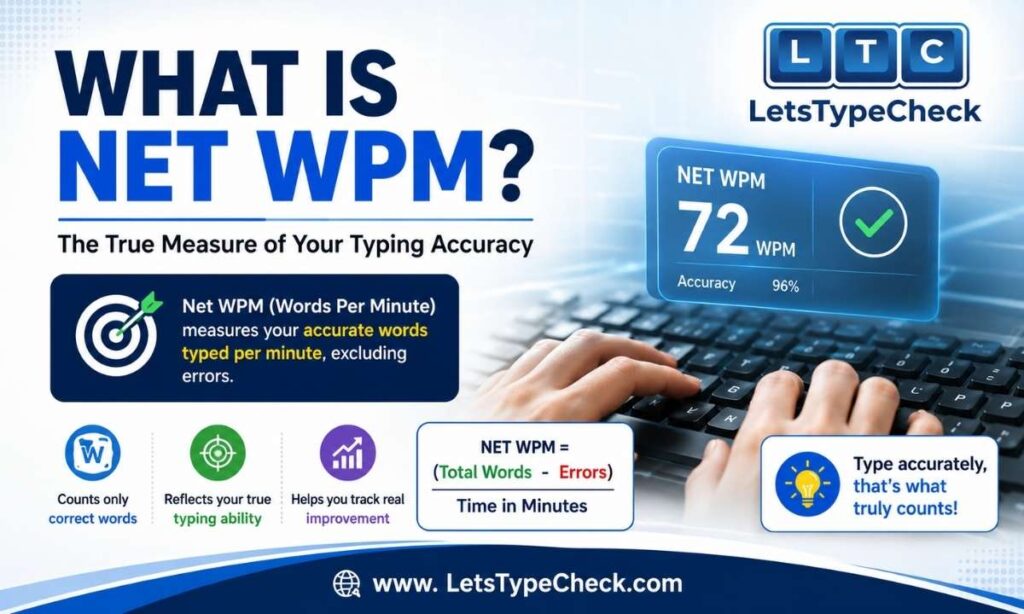
Net WPM starts from your Gross WPM and subtracts a penalty for every error you left uncorrected in the text. It’s the number that reflects what you actually produced — correct, usable words per minute.
Net WPM = Gross WPM − (Uncorrected errors ÷ Minutes)
If you make zero errors, Gross and Net WPM are identical. The moment errors enter the picture, Net WPM drops below Gross WPM — and the gap between the two tells you exactly how much of your “speed” is actually noise.
The Formula Side-by-Side, With a Worked Example
Say you type for one minute and produce 300 characters, with 6 of them being uncorrected mistakes.
Step 1 — Gross WPM: 300 characters ÷ 5 = 60 words. 60 words ÷ 1 minute = 60 Gross WPM.
Step 2 — Net WPM: 60 Gross WPM − (6 errors ÷ 1 minute) = 54 Net WPM.
The same math scales to longer tests. On a 5-minute test with the same 60 Gross WPM pace and 6 total errors, the penalty is spread across 5 minutes instead of 1, so Net WPM only drops to about 58.8 — a much smaller hit. This is one of the most misunderstood parts of typing scores: the same number of mistakes costs you far more on a short test than a long one.
Gross WPM, Net WPM, Accuracy, and CPM — One Reference Table
These four numbers get confused constantly because they all come from the same test. Here’s how they relate:
| Metric | What It Measures | Formula |
| Gross WPM | Raw typing speed, errors included | (Characters ÷ 5) ÷ Minutes |
| Net WPM | Usable, error-adjusted speed | Gross WPM − (Errors ÷ Minutes) |
| Accuracy | % of characters typed correctly | (Correct characters ÷ Total characters) × 100 |
| CPM | Raw speed in characters, not words | Gross WPM × 5 |
If you want the fuller breakdown of how WPM itself is defined and calculated, see What WPM is?. For how CPM fits in and when it’s used instead of WPM, see WPM vs CPM.
How Accuracy Widens the Gross-to-Net Gap

Accuracy is the lever that determines how far your Net WPM falls below your Gross WPM. The table below holds Gross WPM constant at 60 and shows what happens as accuracy slips:
| Gross WPM | Accuracy | Net WPM (approx.) |
| 60 | 100% | 60 |
| 60 | 97% | 58 |
| 60 | 93% | 55 |
| 60 | 88% | 51 |
| 60 | 82% | 47 |
Notice how quickly the score collapses below 90% accuracy. This is why speed drills that ignore accuracy tend to produce a high Gross WPM and a disappointing Net WPM — you’re training the wrong half of the skill. If accuracy is your weak point, How to Type Faster covers technique fixes that raise accuracy without slowing you down.
How Test Length Changes Your Net WPM
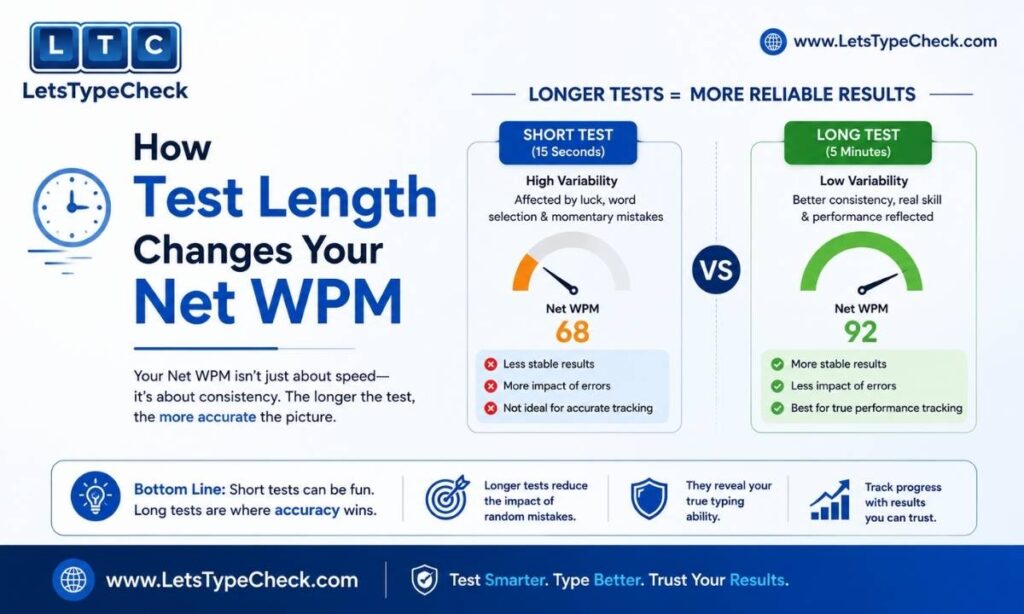
The error penalty in the Net WPM formula is errors divided by minutes — so the same number of mistakes costs you more on a short test than a long one.
| Test Length | Gross WPM | Total Errors | Net WPM (approx.) |
| 30 seconds | 60 | 3 | 54 |
| 1 minute | 60 | 3 | 57 |
| 2 minutes | 60 | 3 | 58.5 |
This is worth knowing if you compare your scores across different test lengths and wonder why they don’t match. A 30-Second Typing Test will always be less forgiving of mistakes than a 2-Minute Typing Test run at the exact same raw speed and error count — the shorter test just doesn’t have enough time to dilute the penalty.
Why Government Exams Score Net WPM Differently
If you’re preparing for SSC, RRB, CPCT, or a similar government typing exam, it helps to know that these tests don’t simply subtract one error per mistake the way most online typing tools do. Most government typing exams use a grace allowance and a half-mistake / full-mistake system:
- A small number of errors (often calculated as a percentage of your total words typed) is forgiven entirely — this is the grace allowance.
- Beyond that grace, a “full mistake” (a wrong word, a skipped word) typically costs 1 full word from your net count, while a “half mistake” (a minor error like a missing capital or an extra space) costs 0.5 words.
- Your final Net WPM is calculated only after the grace allowance is applied and the remaining full and half mistakes are deducted.
This is a meaningfully different scoring model from the flat “one error, one word” penalty used by most casual online typing tests — which means a Net WPM score from a practice tool and a Net WPM score from an actual government exam software are not always directly comparable. If your target is a government exam, practice in Hard Typing Test mode, since exam passages tend to use more complex vocabulary and sentence structures than everyday typing practice.
What Your Own Test Results Actually Tell You
When you finish a test, the results panel shows four numbers: Time Left, WPM, Accuracy, and Mistakes — tracked as separate stats rather than a single combined Gross/Net split. That separation is actually useful: it means you can see your error count and accuracy percentage directly, instead of having them baked invisibly into one blended number.
If you want to estimate your own Gross WPM from those results, you can reverse the Net WPM formula using the Mistakes figure shown at the end of your test — add back roughly one word per mistake, per minute, to approximate what your raw speed would have been with zero errors. The gap between that estimate and your reported WPM is your personal “cost of errors,” and it tends to grow noticeably in Hard mode, where complex sentences and technical terms increase both the chance of a slip and the cost of correcting it. Beginners typically see almost no gap between the two, since Easy mode uses simple, familiar vocabulary that’s harder to mistype in the first place.
Net WPM Standards by Job Role
Employers and exam boards set their minimum WPM requirements in Net WPM, not Gross WPM — a distinction worth remembering when you see a job posting that says “50 WPM required.” For a full breakdown of what counts as a good score by job, age, and exam type, see What Is a Good Typing Speed? and Average Typing Speed by Age — both are built around Net WPM benchmarks.
Common Mistakes When Estimating Your Own Net WPM
If you’re calculating your typing speed by hand rather than relying on a tool, these are the most common places people get it wrong:
- Forgetting to count spaces as characters. The 5-character “word” standard includes spaces and punctuation, not just letters — skipping them undercounts your total.
- Confusing corrected errors with uncorrected ones. A mistake you caught and fixed with backspace generally doesn’t count against your Net WPM directly — though the time you spent fixing it still lowers your Gross WPM, since you typed fewer net characters in the same time window.
- Applying a flat “1 error = 1 word” penalty to a government-exam-style test. As covered above, many exams use a grace allowance and half-mistake system, so a manual calculation using the simple online-test formula will usually underestimate your actual Net WPM on those exams.
- Comparing Net WPM across tests of different lengths without adjusting for it. As shown in the test-length table earlier, the same error count produces a lower Net WPM on a shorter test — so a 30-second score and a 5-minute score aren’t an apples-to-apples comparison.
Why Employers Use Net WPM Instead of Gross WPM
Net WPM predicts something Gross WPM can’t: actual usable output. A typist producing 70 Gross WPM at 85% accuracy generates fewer clean, usable words per hour than one producing 50 Gross WPM at 99% accuracy — the first typist spends real time going back to fix what they typed wrong. In professional settings — legal documents, medical records, financial reports — that correction time (and the risk of an error slipping through uncorrected) matters more than raw finger speed. That’s why Net WPM, not Gross WPM, is the number that appears in job postings, exam requirements, and certification standards.
The Bottom Line
Gross WPM tells you how fast your fingers can move. Net WPM tells you how much of that speed was actually usable. Track Gross WPM if you want to see your raw ceiling — but track Net WPM if you want an honest read on your real typing ability, because that’s the number every employer, exam board, and certification actually checks. Practice with accuracy as the priority, and both numbers will rise together.
Frequently Asked Questions
What is the difference between gross speed and net speed?
Gross speed measures your raw output: total characters typed, divided by 5, divided by the minutes taken. Net speed starts from that figure and subtracts a penalty for uncorrected errors. If you type with no mistakes, both numbers are the same. The more errors you leave in, the further net speed falls below gross speed.
What is the difference between Gross WPM and Net WPM?
Gross WPM counts every character you typed, including mistakes. Net WPM subtracts a penalty for uncorrected errors, so it reflects your actual usable output. The two numbers are identical only when you make zero errors.
Which one should I focus on when practicing?
Net WPM. Chasing a high Gross WPM without controlling accuracy builds fast, sloppy habits. Keep accuracy above 95% first, and your Net WPM will climb naturally as your Gross WPM does.
Does backspacing hurt my score?
Not directly — a corrected error typically isn’t penalized in the Net WPM formula. But the time spent backspacing and retyping still reduces the total characters you produce in the test window, which lowers your Gross WPM regardless.
Why is my Net WPM different on a short test versus a long one?
The error penalty is calculated per minute, so the same number of mistakes costs more on a 30-second test than on a 5-minute test. Longer tests produce more stable, forgiving Net WPM scores.
Do government exams calculate Net WPM the same way as online typing tests?
Not exactly. Most online tools use a simple “one error = one word” penalty. Many government exams (SSC, RRB, CPCT, and similar) use a grace allowance plus a half-mistake/full-mistake system, so the two scores aren’t always directly comparable.
Do employers check Gross WPM or Net WPM?
Net WPM. Job postings, pre-employment typing tests, and certification standards are all expressed in Net WPM because it reflects real, usable output rather than raw keystroke speed.