
If you’ve applied for SSC CGL and seen the number “8,000 KDPH” attached to the Data Entry Speed Test, it probably looked more intimidating than it actually is. Eight thousand of anything per hour sounds like a lot — until you realize it’s not a target you build up to over an hour. It’s a rate, and once you convert it into what you actually do in the 15 minutes you’re given, it turns into a pace most people who type regularly can hit with a few weeks of focused practice.
This guide breaks down exactly what a “key depression” is, how 8,000 KDPH maps onto the real 15-minute test, why you’ll see different WPM numbers quoted for the same requirement, and how the error-marking system actually works — plus where SSC’s official rules end and where commonly repeated coaching-site conventions begin.
What Is the SSC CGL DEST?
The SSC CGL typing component is officially called the Data Entry Speed Test (DEST). It sits inside Tier-II of the exam and applies mainly to Tax Assistant posts under CBDT and CBIC, along with Compiler posts. Unlike many other government typing tests, DEST doesn’t score you in words per minute at all — it scores you in key depressions, which is simply the total number of times you press a key while typing the given passage.
The test itself is qualifying, not merit-based. You don’t get bonus rank for typing faster than the threshold — you either clear the minimum standard or you don’t, and if you don’t, you’re out of contention for the post regardless of how well you did in the written papers.
What Is a Key Depression? (KDPH Explained)
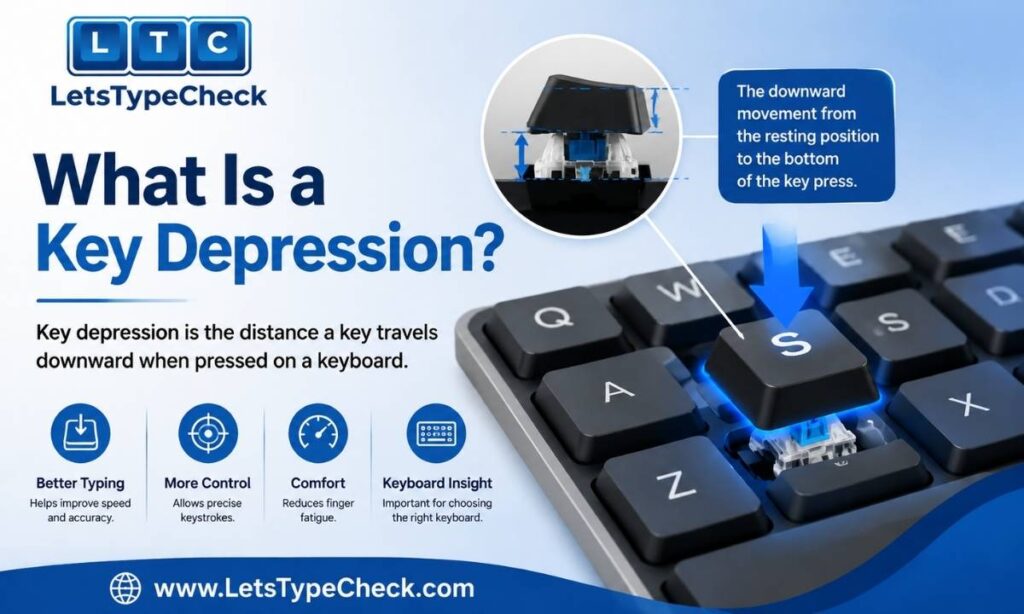
A key depression is exactly what it sounds like: one press of one key. Every letter counts as one. Every space counts as one. Every comma, full stop, or Shift key you hold down to capitalize a word — all of it counts. This is different from how most typing tests you’ve probably used before measure speed.
Most online typing tests, and most other government exams, report speed in words per minute (WPM), where a “word” is defined as any five characters, including spaces — not an actual dictionary word. SSC CGL’s DEST skips that abstraction entirely and just counts raw keystrokes. That’s the entire reason the number looks unusually large: 8,000 key depressions sounds far more demanding than “27 WPM,” even though they describe roughly the same physical effort.
KDPH, then, is just “key depressions per hour” — a rate. SSC states it as an hourly rate for standardization, even though your actual test is 15 minutes, not an hour. Scaled down, 8,000 KDPH works out to 2,000 key depressions in a 15-minute test — and that 2,000-key-depression figure is the number you’ll actually be typing toward on exam day.
8,000 KDPH → WPM: The Actual Math
Here’s the conversion shown step by step, since neither the official notification nor most typing sites actually walk through it:
- Step 1: 8,000 key depressions per hour ÷ 4 = 2,000 key depressions in the 15-minute test window.
- Step 2: Convert key depressions to “words” using the standard 5-characters-per-word convention: 2,000 ÷ 5 = 400 words.
- Step 3: Divide by the test duration to get WPM: 400 words ÷ 15 minutes ≈ 26.7 WPM, commonly rounded to roughly 27 WPM.
That’s where the “27 WPM” figure you’ll see quoted around the internet comes from. It’s a derived, unofficial conversion — not a number SSC itself publishes — but the math behind it is straightforward and consistent.
A different way to look at the same target that’s often more useful for pacing: 2,000 key depressions over 15 minutes works out to about 133 key depressions per minute, or a little over 2 keystrokes per second. Framed that way, “8,000 KDPH” stops sounding like a wall you have to climb and starts looking like a steady, sustainable typing rhythm — which is exactly what it’s designed to measure.
Is There an Official WPM Requirement?
This is where a lot of confusion comes from, because you’ll find two different claims across coaching sites and typing platforms.
Some sources state plainly that SSC does not publish a WPM figure for CGL DEST at all — that the only officially defined criterion is completing roughly 2,000 key depressions in the 15-minute window with acceptable accuracy, and that any WPM number attached to it is an unofficial conversion layered on top by coaching sites.
Other sources apply the exact same WPM figures used for the separate SSC CHSL typing test (35 WPM English, 30 WPM Hindi) directly to CGL DEST, as if it were the same rule.
The honest answer sits between the two: the 2,000-key-depressions-in-15-minutes figure is the solid, consistently reported number across sources describing the DEST format. The 35/30 WPM figures are CHSL’s actual published requirement for a separate exam — useful as a comparison and as a safety-margin target, but not something SSC has stated as CGL DEST’s own official WPM threshold. Treat “~27 WPM” as a helpful mental benchmark for pacing, not as the literal number SSC is scoring you against.
Test Format & Duration
The format itself is consistent across sources and worth locking in before anything else:
| Component | Language | Duration | Note |
| DEST | English | 15 minutes | Speed is measured by keystrokes, not by words |
| DEST | Hindi | 15 minutes | Runs on the same 15-minute clock as the English version |
| DEST — PwBD candidates with a scribe | English / Hindi | 20 minutes | 5 extra minutes built in as compensatory allowance |
| Typical passage | — | — | Sized to roughly 2,000 keystrokes |
Before the timed test itself, most SSC typing centers run a short mock/demo window — commonly around two minutes — where you can get used to the software, check that the font is displaying correctly, and get a feel for keyboard responsiveness before the clock that counts starts running.
Backspace, Editing & Interface Rules

This is one detail worth clarifying carefully, because you’ll see it described two different ways depending on the source. Some describe DEST as allowing backspace and correction. Others describe SSC’s typing software — shared across both CHSL and CGL — as locking out most editing conveniences entirely: no undo, no autocorrect or spell check, no cut/copy/paste, cursor arrow keys that don’t respond, and neither backspace nor delete able to remove a character once it’s typed.
Given that both the CHSL and CGL typing tests run on the same SSC-NIC exam software, and that SSC’s own candidate instructions describe both tests together as skill tests of a “qualifying nature” administered under one system, it’s safer to prepare assuming backspace is disabled and build your habits around typing forward through mistakes rather than correcting them, than to assume correction is available and be caught off guard on exam day. Always confirm the exact interface behavior against your specific admit card and center instructions closer to your exam date, since exact software configuration can vary by cycle.
Fonts & Keyboard
English passages show up on screen in 12-point Times New Roman, sitting inside a Word-style text box rather than a plain terminal window. You’ll be typing on whatever QWERTY keyboard is bolted to your assigned terminal — bringing your own isn’t allowed — so it’s worth rotating through a few different physical keyboards during practice instead of training exclusively on the one at home. Keys can feel noticeably different from one board to another, and that adjustment costs you time if it’s happening for the first time on exam day.
Elsewhere in the SSC system, Hindi-medium typing generally comes down to one of two font-and-layout pairings: Mangal paired with the Unicode Inscript keyboard, or the older Krutidev 010 paired with a Remington-style layout. This is more general SSC background than a CGL DEST specific, since DEST itself is built around English passages for Tax Assistant and Compiler posts.
Error / Mistake System
SSC’s CGL notification itself doesn’t spell out a per-character error formula for DEST — the evaluation methodology and tolerance are described only in broader SSC communications, not the notification document. The mistake-counting convention widely applied across SSC’s typing tests, DEST included, is a Full/Half split: a Full Mistake (a wrong word, a missing word, or an extra word not in the passage) costs a full word from your gross count, and a Half Mistake (a correct word with a spacing, capitalization, or punctuation slip) costs half a word. Category-wise tolerance commonly cited alongside it runs 20% for General/Unreserved, 25% for OBC/EWS, and 30% for SC/ST, measured against the passage’s total character count.
Since this scoring system, the full formula, and worked pass/fail examples are covered in depth in our Gross vs Net WPM guide, here’s a shorter example specific to DEST’s own unit — key depressions, not words:
- You make 2,050 key depressions in the 15-minute test, but the evaluator flags 9 full mistakes and 14 half mistakes.
- Converting each mistake type to keystrokes at the standard 5-per-word ratio: 9 full mistakes × 5 = 45 keystrokes, 14 half mistakes × 2.5 = 35 keystrokes — a combined deduction of 80.
- Net key depressions: 2,050 − 80 = 1,970 — just short of the 2,000 target on paper, but typically still inside the qualifying range once category-wise tolerance is applied.
The pattern that matters more than any single number: gross speed alone doesn’t decide the outcome. A candidate typing fast but carelessly can land behind a slightly slower, cleaner typist once mistakes are converted and deducted.
DEST vs CHSL vs RRB NTPC at a Glance
If you’re preparing for more than one government typing test at once, here’s how the major ones compare on structure:
| Exam | Metric Used | Duration | Nature |
| SSC CGL (DEST) | Key depressions (2,000 in 15 min ≈ 8,000 KDPH) | 15 minutes | Qualifying only |
| SSC CHSL | WPM (35 English / 30 Hindi) | 10 minutes | Qualifying only |
| RRB NTPC | WPM (30 English / 25 Hindi) | 10 minutes | Qualifying only |
For a full breakdown of the CHSL format specifically — including its own error rules and preparation timeline — see our SSC CHSL Typing Test guide (linked separately). The core takeaway for CGL specifically: it’s measured differently, runs longer per attempt, and is scored on raw keystrokes rather than words, so training only on WPM-based tools without ever practicing a full 2,000-key-depression stretch can leave a gap in your exam-day stamina.
How to Practice for 8,000 KDPH

Since DEST is qualifying rather than merit-ranked, the goal isn’t to maximize your score — it’s to clear the threshold reliably, with enough margin that a nervous exam-day slowdown doesn’t push you under it. A practical approach:
- Practice in full 15-minute sessions, not short bursts — DEST tests sustained pace and stamina, not a quick sprint. Our own 2-minute typing test is a good building block, but stack multiple rounds back to back to simulate the full stretch.
- Prioritize accuracy before speed in the first couple of weeks — build the habit of typing forward through visible mistakes rather than trying to fix them, since backspace should not be relied on.
- Once accuracy is solid, layer in speed using progressively harder practice text — our Hard Typing Test mode, with more complex vocabulary and sentence structure, is a reasonable proxy for the formal, prose-heavy passages SSC tends to use.
- Build toward a working target north of the ~27 WPM pacing benchmark — aiming for roughly 32–35 WPM in practice gives you a buffer for the accuracy drop that comes with exam-day nerves.
- Use a structured routine rather than random daily typing — our Typing Practice Exercises guide lays out a full weekly schedule you can adapt toward a 15-minute-endurance goal.
Self-Check: Are You DEST-Ready?
Our tool tops out at 2 minutes per test rather than offering a full 15-minute mode, but you can still get a solid readiness read without it. Run the 2-minute Hard difficulty test three times back to back with only a short break between attempts, and look at two numbers: your WPM and your Mistakes count.
- If your WPM stays reasonably consistent across all three attempts (not dropping sharply on the third), that’s a good sign of the stamina DEST actually tests.
- If your Mistakes count climbs noticeably in later attempts, that’s fatigue-driven accuracy loss — exactly the failure pattern that costs candidates the qualifying threshold in the real 15-minute test.
- Aim to comfortably clear roughly 32+ WPM on Hard mode across repeated attempts before treating yourself as exam-ready — that buffer above the ~27 WPM benchmark is what actually protects you on the day.
Exam-Day Checklist
A few decisions are much better made days in advance than in the seat: which language you’re typing in, and which font/layout applies if that’s relevant to your posting, should both be settled long before you’re sitting at the terminal — not something you’re figuring out as the demo window opens.
Keep your final speed-focused practice session a couple of days out rather than the evening before. A late cram session tends to spike nerves more than it adds usable speed, and walking in tired from a last-minute push works against you more than it helps. Give yourself enough buffer getting to the center that you’re settled rather than out of breath when you sit down.
Treat the two-minute demo as a genuine dry run rather than dead time — actually type through it. It’s your only chance before the clock that counts to confirm the keyboard responds the way you expect and the passage text is rendering cleanly on screen.
Frequently Asked Questions
What exactly counts as a “key depression”?
Every keystroke you make while typing the passage — every letter, every space, every punctuation mark, and every Shift key press used for capitalization. It’s a raw keystroke count, not a word count.
How much typing speed is required for SSC CGL DEST?
SSC’s consistently reported requirement is roughly 2,000 key depressions in the 15-minute test (equivalent to 8,000 KDPH). A WPM figure isn’t SSC’s own stated metric for CGL specifically — the commonly cited ~27 WPM is a derived conversion, useful for pacing but not an official published threshold the way it is for CHSL.
Is 8,000 KDPH difficult for a beginner?
Not inherently. Once converted to pace, it works out to roughly 133 key depressions a minute — a steady, sustainable rhythm rather than a burst of speed. Most of the difficulty candidates run into comes from accuracy and stamina over the full 15 minutes, not from the raw speed requirement itself.
Is the SSC CGL DEST qualifying or does it add marks?
It’s qualifying only. It does not add marks to your final merit score, but failing it removes you from consideration for the post regardless of how you scored in the written papers.
Can I use backspace during the SSC CGL DEST?
Sources disagree on this point, so it’s safer to prepare as if none of the usual editing shortcuts are available — no backspace, no delete, no arrow-key repositioning, no cut/copy/paste, no undo, no autocorrect — matching how SSC’s shared typing software is generally described. Confirm the exact behavior against your own admit card and center instructions closer to your exam date.
Does the SSC CGL DEST have a separate exam date?
No — it’s conducted on the same day as the Tier-II objective paper, in the same session window, rather than on a separate typing-specific date.
Is the SSC CGL typing test in Hindi or English?
DEST for CGL is primarily associated with English-passage typing for Tax Assistant/Compiler posts; language settings can vary by center and cycle, so check your specific admit card and regional office communication.
Are there official previous-year DEST passages available to practice from?
SSC does not officially release previous DEST passages. Practice material available online is built to approximate the length, difficulty, and formal prose style of real exam-style passages, not sourced directly from past exams.
Ready to build the stamina and accuracy DEST actually tests? Start with a 2-minute typing test, push into Hard mode once your accuracy is solid, and follow a structured daily practice routine to build toward exam-day readiness.